Why Long Language Streak Fit No Improve Your Speaking
Long learning streak prove consistency, but e no always mean speaking practice. Learn how to turn your habit into conversation progress wey you fit measure.
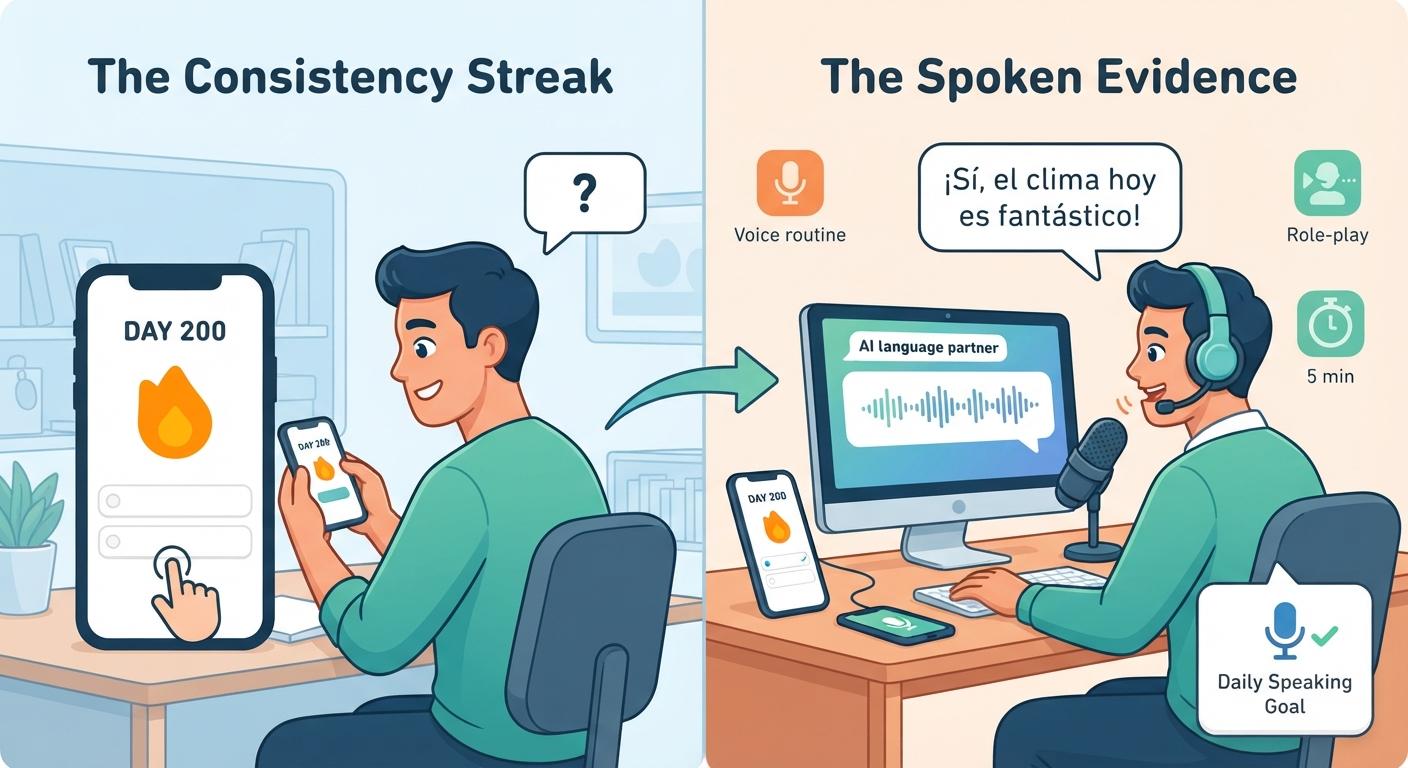
Imagine say you don reach day 200 of your language-learning streak. You don open the app, complete the activity, and protect the counter almost every day. Then person ask you simple question for the language, but your answer no come.
Dis situation no mean say the 200 days waste. E mean say the streak and your speaking goal dey measure different things.
Streak dey record consistency. Depending on the activities behind am, those 200 sessions fit don strengthen your vocabulary, grammar awareness, reading, listening, or ability to remember words. But counter no fit show whether you don practice how to start answer, follow unexpected question, recover after you forget word, or speak long enough to complete idea.
Wetin streak prove—and wetin e no prove
Long streak prove something valuable: you don make language learning repeatable. You find time, place, or trigger wey dey bring you back even when your motivation change. Plenty learners struggle to build dat kind consistency at all.
But the number alone no tell you:
- which language skills you use;
- how difficult the activity be;
- whether you produce language or just select answer;
- whether you respond under time pressure;
- whether you apply feedback from earlier session; or
- whether the task become more challenging as you improve.
Dis no be criticism of streaks. Na measurement problem. Step counter fit tell you how many steps you take, but e no fit tell whether you ready for particular hike. In the same way, activity counter fit show say you study, but e no fit show whether you fit handle conversation about your work, introduce yourself to new neighbour, or ask for help while you dey travel.
To understand language no be the same as to produce am
You fit recognize word immediately for lesson and still struggle to remember am when you need speak. You fit understand complete sentence as you dey listen, but need more time to build similar sentence by yourself.
Language researchers often separate receptive use—understanding language through listening or reading—from productive use through speaking or writing. The relationship complex pass simple “recognition versus recall” division. One review of vocabulary knowledge and assessment note say recognition and recall tests no connect neatly to the ability to understand or produce words for real communication.
The practical lesson simple: reading, listening, vocabulary study, and grammar work fit all support speaking, but success for those activities no automatically show spontaneous speaking ability. You need chances to turn meaning into your own words, listen to reply, and respond again.
You dey improve for the task wey you repeat
If your daily activity ask you to match word to picture, you fit become faster and more accurate for dat task. If e ask you to choose missing word, you fit improve how you notice the answer wey fit. Those gains real. Dem just fit no include the full sequence wey conversation require:
- understand wetin another person mean;
- decide wetin you want talk;
- remember useful words and structures;
- pronounce answer clearly enough for person to understand; and
- adapt when the response no be wetin you expect.
Speaking also expose gaps wey guided exercise fit hide. No list of possible answers fit dey, no written sentence to guide you, and no pause button while another person dey wait. Na why person fit perform well for familiar app exercises but still hesitate for conversation wey dem no rehearse.
The ACTFL Proficiency Guidelines describe language ability separately for speaking, listening, reading, and writing, and dem focus on wetin person fit do for spontaneous, real-world situations. You no need formal proficiency test to use the same principle: measure the ability wey you truly want build.
Check the last seven days of your streak
Before you change your routine, look wetin e dey train now. Review your last seven sessions and answer these questions for each day:
- I speak aloud, or I only think about the answer?
- I create my own sentence without choosing from options?
- I listen to complete question and respond to the meaning?
- I need start before I get time to plan perfect answer?
- I receive or identify one useful correction?
- I try the sentence or situation again after the correction?
- I continue speaking beyond one short phrase?
Count the days wey include most of these actions. The goal no be to produce good or bad score. Na to make the contents of the streak visible.
You fit discover say you study every day but speak for only one day. Or maybe you speak often, but only repeat scripted sentences. Dat result give you specific adjustment to make; e no erase the vocabulary, understanding, or discipline wey you don build already.
Keep the streak and redefine your daily minimum
No respond to dis discovery by replacing sustainable habit wit exhausting plan. Attach one speaking action wey you fit observe to the routine wey you already get.
Your new daily minimum fit be:
- answer one familiar question for 60 seconds;
- complete five-minute role-play;
- retell short story without reading am;
- record voice note about your day;
- explain one idea and answer two follow-up questions; or
- retry yesterday corrected sentence for new context.
Choose one action wey small enough to complete even for difficult day. Lessons and exercises fit remain part of the session, but the streak complete only after the speaking action.
For example, “study Spanish” difficult to observe. “Explain wetin I do dis morning for one minute without reading notes” clear. You know whether you try am, and the recording give you evidence wey you fit compare later.
If you need ready-made structure, use dis fifteen-minute daily speaking routine as your practical next step.
Add one speaking test wey you fit repeat every week
Daily practice show say you turn up. Weekly test help you see wetin dey change.
Choose one task wey connect to real goal:
- answer “Tell me about yourself” as if you dey meet new colleague;
- role-play how to order food and ask about ingredient;
- explain current project to person outside your field;
- retell the same short story wit your own words; or
- describe problem to hotel receptionist and answer follow-up questions.
Record the first attempt. Repeat the same task seven days later under similar conditions, without memorizing script. Repetition make comparison easier because the topic no dey change every time. Research on repeating second-language speaking tasks find improvements for some parts of oral fluency during repeated performance, although one task and one week no fit measure your overall proficiency.
After two or three comparisons, change one detail: the person, setting, tense, or follow-up question. Dis check whether you fit use familiar language wit some flexibility instead of reciting one polished answer.
Measure signs of speaking progress wey you fit observe
“I still no feel fluent” understandable, but e too broad to guide tomorrow practice. Use few concrete signs instead:
- Time to start answer: About how many seconds pass before you begin?
- Sustained speaking: How long you fit continue before the idea stop, without counting natural pauses?
- Clarity: Listener fit follow your main point without seeing script?
- Recovery: When word disappear or sentence break, you fit explain am another way and continue?
- Response: You fit understand and answer follow-up question instead of delivering only prepared monologue?
- Reuse of corrections: You fit apply phrase wey dem correct last week for new sentence?
No try improve every measure at once. Choose one or two for one week. Shorter answer wey start quickly fit be progress. Slower answer where you recover from mistake instead of abandoning the conversation fit also be progress.
If delayed recall na the main problem, dis guide about how to stop constant translation for your head explain how to practice faster route from meaning to speech.
Make lessons and vocabulary support the conversation
The reset no be “stop studying and only talk.” Speaking without enough input, vocabulary, or feedback fit leave you repeating the same limited language. Better change na to connect your supporting study to communication task.
Try dis sequence:
- Choose real situation wey you want handle.
- Study short lesson or small set of phrases for dat situation.
- Use the language for spoken answer or role-play.
- Notice one gap or correction.
- Review am and retry the situation.
Now vocabulary get destination. Grammar help you make particular meaning clearer. Listening prepare you for replies wey you fit hear. Then the conversation reveal wetin you need study next.
Turn your Liplip routine into meaningful daily action
Liplip combine AI conversations, lessons, exercises, and vocabulary practice for personalized Roadmap based on your profile and evaluated level. Dat structure let you keep guided learning journey while e include chances to use language for context.
Connect the daily action to real-life goal: talk wit colleague, prepare for travel, introduce yourself, or discuss topic wey matter to you. Complete the relevant Roadmap work, then make actual conversation the evidence say today habit serve dat goal.
Counter no fit decide whether you practice the skill wey you want. You fit. Keep the consistency wey carry you through long streak, but make am produce something wey meaningful pass another completed day.
Start conversation wit Liplip and turn today learning session into speaking practice wey connect to real goal.