English for Call Center Interviews: Questions and Practice
Prepare for an English call-center interview with common questions, adaptable answers, customer-service phrases, pronunciation practice, and realistic role-plays.
A call-center interview tests more than your ability to memorize answers. When you apply for a customer-service role, the interviewer is evaluating how you will sound on the phone with a real, sometimes frustrated, customer.
They are listening for understandable speech, active listening, composure under pressure, professionalism, and customer-focused reasoning. They want to know if you can explain a solution clearly, keep your tone steady, adjust for a difficult customer, and maintain focus during back-to-back calls.
This guide will help you prepare for an English call-center interview by practicing realistic questions, learning useful phrases, and structuring your answers effectively.
Communication matters more than a perfect accent
Many English learners worry that they will fail an interview because they do not have a "native" accent. In reality, call centers hire people with diverse accents every day.
What matters is clarity. Can the customer understand your instructions? Do you speak at a steady pace? Can you pronounce numbers, names, and key terms clearly over a phone line?
Focus on clear pronunciation, confident pacing, and professional vocabulary rather than trying to imitate a specific regional accent.
Practise a concise "Tell me about yourself"
This is often the first question in any interview. For a call-center role, keep your answer focused on your relevant experience, communication skills, and motivation for customer service.
Example structure:
- Present: Your current situation or recent experience.
- Past: Relevant skills you have developed (problem-solving, communication).
- Future: Why you want this specific role.
"I have spent the last two years working in retail, where I learned how to handle busy shifts and assist customers with different needs. I realized that I enjoy solving problems and helping people find the right information. I am applying for this call-center position because I want to bring my communication skills to a structured environment where I can support customers over the phone."
Prepare adaptable answers for common questions
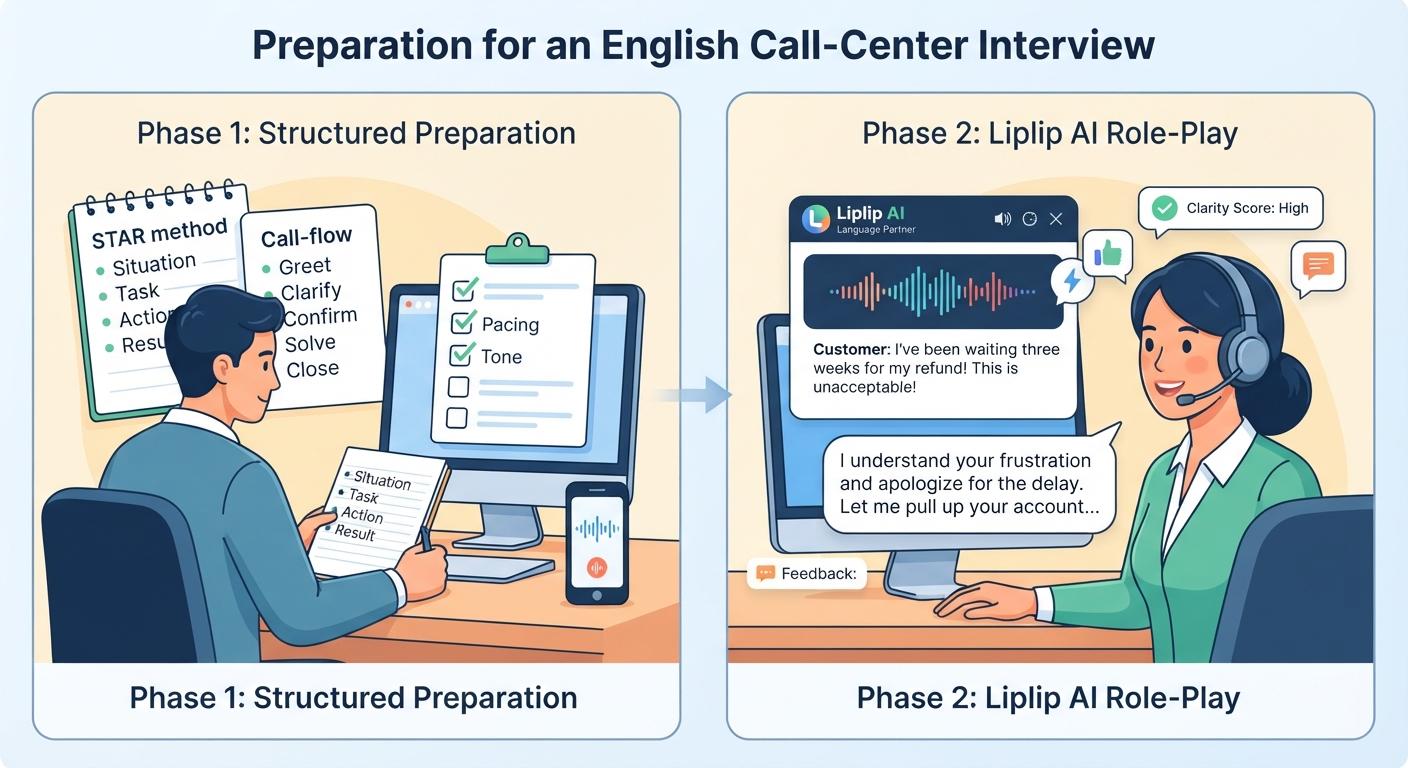
Call-center interviews frequently use behavioral questions to see how you handle real situations. Use the STAR method (Situation, Task, Action, Result) to structure your stories.
Here are common questions and how to approach them:
1. "Tell me about a time you dealt with an angry customer. What did you actually say?"
What they want to know: Can you remain calm and de-escalate a situation without taking it personally? How to answer: Describe a specific situation. Focus on your tone, how you listened, and the steps you took to find a solution.
"A customer was upset because their delivery was late. I listened without interrupting and said, 'I understand why you are frustrated, and I apologize for the delay. Let me check the tracking system right now to see exactly where your package is.' I found the issue, explained the new delivery time, and offered a small discount for the inconvenience. The customer calmed down and thanked me for the quick update."
2. "If you do not know the answer to a question during a live call, what do you do?"
What they want to know: Are you honest, and do you know how to use your resources? How to answer: Never say "I don't know" and stop there. Explain how you would find the answer.
"I would tell the customer, 'That is a great question. Let me look up the exact details for you so I give you the correct information. May I place you on a brief hold while I check our system?' Then, I would consult the knowledge base or ask a supervisor."
3. "How do you stay focused when you have back-to-back calls?"
What they want to know: Can you handle the pressure and repetition of the job? How to answer: Mention your organizational skills and ability to reset between interactions.
"I treat every call as a fresh start. Even if the previous call was difficult, I take a deep breath, review the new caller's details quickly, and greet them with a positive tone. I also make sure to take clear notes during the call so I don't fall behind."
4. "Tell me about a time you made a mistake or received feedback you disagreed with."
What they want to know: Are you coachable and willing to take responsibility? How to answer: Focus on what you learned and how you adjusted your behavior, rather than defending the mistake.
"In my last job, a manager told me I was spending too much time on each customer interaction. At first, I felt I was just providing good service, but I realized they were right about the wait times for other customers. I asked my manager for tips on how to close conversations more efficiently, and within a week, I improved my average handle time without losing positive feedback."
Learn a simple customer-call structure
Understanding the standard flow of a support call will help you in role-play scenarios during the interview.
- Greet: "Thank you for calling [Company]. My name is [Name]. How can I help you today?"
- Clarify: "Just to make sure I understand, you are calling because..."
- Confirm: "Could I please have your account number to look into this?"
- Solve or Escalate: "Here is how we can fix this..." or "I need to transfer you to our technical team who can resolve this for you."
- Close: "Is there anything else I can assist you with today? Thank you for calling, and have a great day."
Use practical phrases for phone communication
Memorize these phrases to sound professional and polite, especially when you need to control the flow of the conversation.
Asking a customer to repeat:
- "I apologize, the line is a bit unclear. Could you please repeat that?"
- "Could you spell your last name for me, please?"
Checking understanding:
- "Let me repeat that back to make sure I have it right."
- "So, if I understand correctly, you want to..."
Placing someone on hold:
- "May I place you on hold for two minutes while I check your account?"
- "Thank you for holding. I have the information you need."
Role-play an upset-customer scenario
Interviewers often ask you to role-play a difficult call. The key is to avoid sounding defensive and to never make promises you cannot keep (like "I promise it will arrive tomorrow" if you aren't sure).
Customer: "I have been waiting for my refund for three weeks! This is unacceptable!" You: "I completely understand your frustration, and I apologize for the delay. Three weeks is a long time to wait. Let me pull up your account right now and see exactly what is causing the hold-up. Could you please provide your order number?"
Notice how this response validates the customer's feelings, apologizes for the situation, and immediately moves toward an action.
Improve phone clarity
When speaking on the phone, the listener cannot see your face or gestures. Your voice must carry all the meaning.
- Pacing: Speak slightly slower than you would in person. When we are nervous, we tend to speed up. If you feel yourself rushing, take a breath and slow down.
- Word stress: Emphasize the most important words in a sentence. ("I can process that refund for you today.")
- Numbers and names: Read numbers clearly and in groups (e.g., "four-five-two, zero-one-nine"). Use the phonetic alphabet if necessary ("A as in Alpha, B as in Bravo").
If you struggle to retrieve words quickly, read our guide on How to Stop Translating in Your Head When Speaking for techniques to build a faster route from meaning to speech.
Record your answers and score observable behaviors
Do not judge your practice by asking, "Did I sound like a native speaker?" Instead, record yourself answering interview questions and score your performance on these observable behaviors:
- Did I begin my answer promptly?
- Did I use the STAR method for behavioral questions?
- Was my tone polite and professional?
- Did I speak at a steady, understandable pace?
- Did I explain my reasoning clearly?
Practise thinking and responding with Liplip
Practicing for a call-center interview requires more than reading a list of questions. You need to experience the pressure of responding to a prompt and speaking your answer aloud.
Liplip provides private, repeatable AI conversations adapted to your level and goals. You can request a specific customer-service scenario, take the agent role, practise your responses, and receive focused feedback on your clarity and phrasing.
Instead of feeling embarrassed while practicing with a partner, you can repeat a difficult scenario on Liplip until you feel confident. It is a powerful way to build the specific speaking skills you need for employment.
A short practice plan
Try this routine to prepare for your interview:
- Day 1: Write down bullet points (not full scripts) for your "Tell me about yourself" answer and three STAR stories.
- Day 2: Record yourself answering three common interview questions. Listen back and check your pacing.
- Day 3: Open Liplip and ask the AI to role-play an angry customer scenario. Practice de-escalating the situation.
- Day 4: Review the standard call structure and practice greeting, placing on hold, and closing a call aloud.
- Day 5: Do a full mock interview on Liplip, asking the AI to ask you five call-center interview questions and provide feedback on your clarity.
Start a conversation with Liplip today. Describe the call-center role you want, and practise one interview or customer scenario at a time to build the confidence you need to succeed. For a broader habit, explore our guide on building a simple daily speaking routine.